• Link to Instagram
  • Link to X
  • Link to Facebook
  • Link to LinkedIn
  • EN
  • ES
  • PT
  • ID
  • FR
Global Alliance of Territorial Communities
  • Home
  • About
  • News & Events
  • Movements
  • Shandia
  • Donate
  • Menu Menu
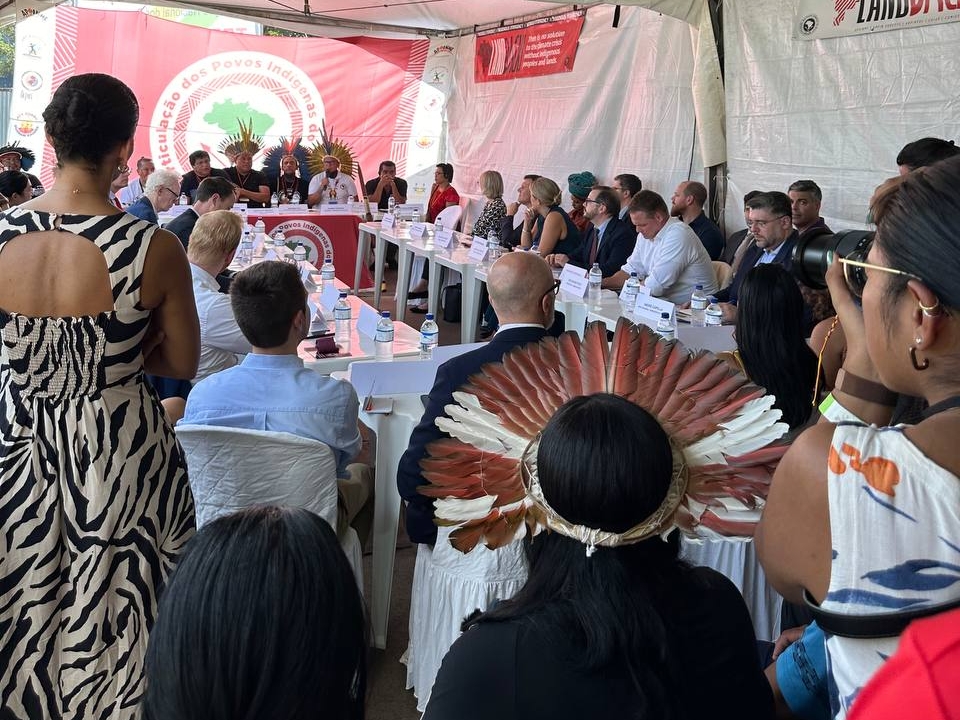
Dinamam Tuxa of APIB speaks at a conference with ministers from various Global North countries

From Brasilia, a Call for Governments to Work for Indigenous Peoples of the World Towards COP30

May 6, 2024/in News/by GATC

Indigenous Peoples of Brazil met with over a dozen of Brasilia’s  ambassadors to call on governments to support their agenda towards COP30 with swift action to stop deforestation and violence in indigenous lands.

April, 2024 — Brazil’s indigenous movement is seeking multiple pathways to ensure the upcoming COP30 can be marked by action in the territories. In a meeting with over a dozen embassies, they asked governments to commit to halting their countries’ extractive activities in indigenous lands. As the country gears up to host the upcoming COP30, there is a need to match discourse with on the ground action, according to the Articulation of Indigenous Peoples of Brazil (APIB). 

During the meeting, leaders from all biomes of Brazil stated the links between land invasion and foreign interest, particularly highlighting the violence communities experience due to displacement and confrontations with invaders and corporations. 

“Don’t receive soy exports that are linked to indigenous blood. If a product is coming from our lands, it is the result of a direct attack on us and is tainted by violence”, said Norivaldo Mendes, from the Guarani Kaiowa people and Executive Coordinator to Aty Guasu and APIB. “Corporations won’t tell you where the soy comes from because they don’t want to lose all the resources our land provides them”, he finished. 

The delegation met with representatives from Australia, Austria, Belgium, Canada, Denmark, the United States, France, Italy, Norway, New Zealand, Sweden, Switzerland, the United Kingdom, the European Union, and the Brazilian Ministries of Foreign Affairs and of Indigenous Peoples. This marks the first time the APIB hosts a single meeting with a diplomatic body of this calibre. 

indigenous leaders and ambassadors from Global Norh countries gather outside a dome for a group photo during the Acampamento Terra Livre, they are holding flags under a cloudy sky
young indigenous leader Txai Surui speaks during a meeting with Global North ambassadors

Among the petitions from the indigenous leadership, they called on these governments to support effective Indigenous participation in COP30 and to include concrete goals for demarcating Indigenous Lands in the upcoming update of the Brazilian Nationally Determined Contributions (NDCs); to implement direct financing to Indigenous organisations by adapting their operations, monitoring and evaluation instruments; and to prioritise a new vision on infrastructure that respects Free, Prior, Informed Consent and that does not impact Indigenous Lands – explicit demanding no mineral or oil exploitation in their territories. 

The ambassadors heard a call for them to hold companies accountable for damage incurred against nature and the inhabitants of the regions in which they operate; and to commit to not financing or supporting projects that are characterised as greenwashing.

“We want to push for traceability of the commodities sold to the European Union and big economies of the Global North, because then you will be able to see why we are constantly calling out violent land grabbing attacks” said Dinamam Tuxa, Executive Coordinator to APIB. 

The leadership also pushed a debate on mining expansion as a response to the climate crisis and a proposal for “sustainable” development. “There is no point in coming to Brazil to look for what has already been used up in your countries”, said Executive Coordinator Kreta Kaingang, speaking on fossil fuel and mining projects.  “We are not against development, but we cannot accept development that is based on the death of our people”, he added.

young indigenous leader Txai Surui speaks during a meeting with Global North ambassadors
Kleber Karipuna in a feathered head piece addresses the conference with a microphone, wearing a white shirt with beaded accessories
Levi Sucre Romero from Costa Rica speaks at during a meeting with ambassadors, he is under a red APIB banner, wearing a black shirt
Rukka Sombolinggi of AMAN, in glasses and a red shirt with traditional fabric, speaks at a conference

The Global Alliance of Territorial Communities (GATC) leadership joined Brazilian Indigenous authorities for the meeting, as part of their participation in the Free Land Camp (Acampamento Terra Livre – ATL) to advance a joint agenda towards COP30 and call on other stakeholders to join their efforts. Their presence showcased the articulation between Indigenous Peoples and Local Communities worldwide. 

“On behalf of the Indigenous Peoples of our alliance, we want governments to join us to make COP30 a historic turning point in how the world confronts the climate crisis. If we don’t come together, we might have to sit down to write the history book on how humanity failed to live with Mother Earth”, said Rukka Sombolinggi, in representation of the Indigenous Peoples of Indonesia and the GATC.  

Representatives from the embassies acknowledged the guardianship role Indigenous Peoples carry in their territories and pledged to continue on dialogues with APIB in the route to COP30. Moreover, they spoke of their standing projects and the will to continue investing and connecting with the communities. Many promised to work both with indigenous organisations and the Brazilian government to  accelerate the demarcation and effective protection of indigenous lands, guaranteeing the autonomy of the people, and strengthening territorial governance.
https://globalalliance.me/wp-content/uploads/2024/05/Copia-de-msg-4106301538-7335.jpg 719 1280 GATC https://globalalliance.me/wp-content/uploads/2023/07/global-alliance-of-territorial-communities-logo-tight.png GATC2024-05-06 17:19:532024-10-25 22:32:40From Brasilia, a Call for Governments to Work for Indigenous Peoples of the World Towards COP30
indigenous leader speaks with Sonia Guajajara and President Lula of Brazil at Palácio do Planalto

Brazil Creates an Indigenous Task Force to Advance Land Rights in the Country

May 3, 2024/in News/by GATC

Indigenous land titling in Brazil has fallen behind as president Lula had promised to complete 14 processes in his first 100 days of government, but had only titled 10 in over a year in power.

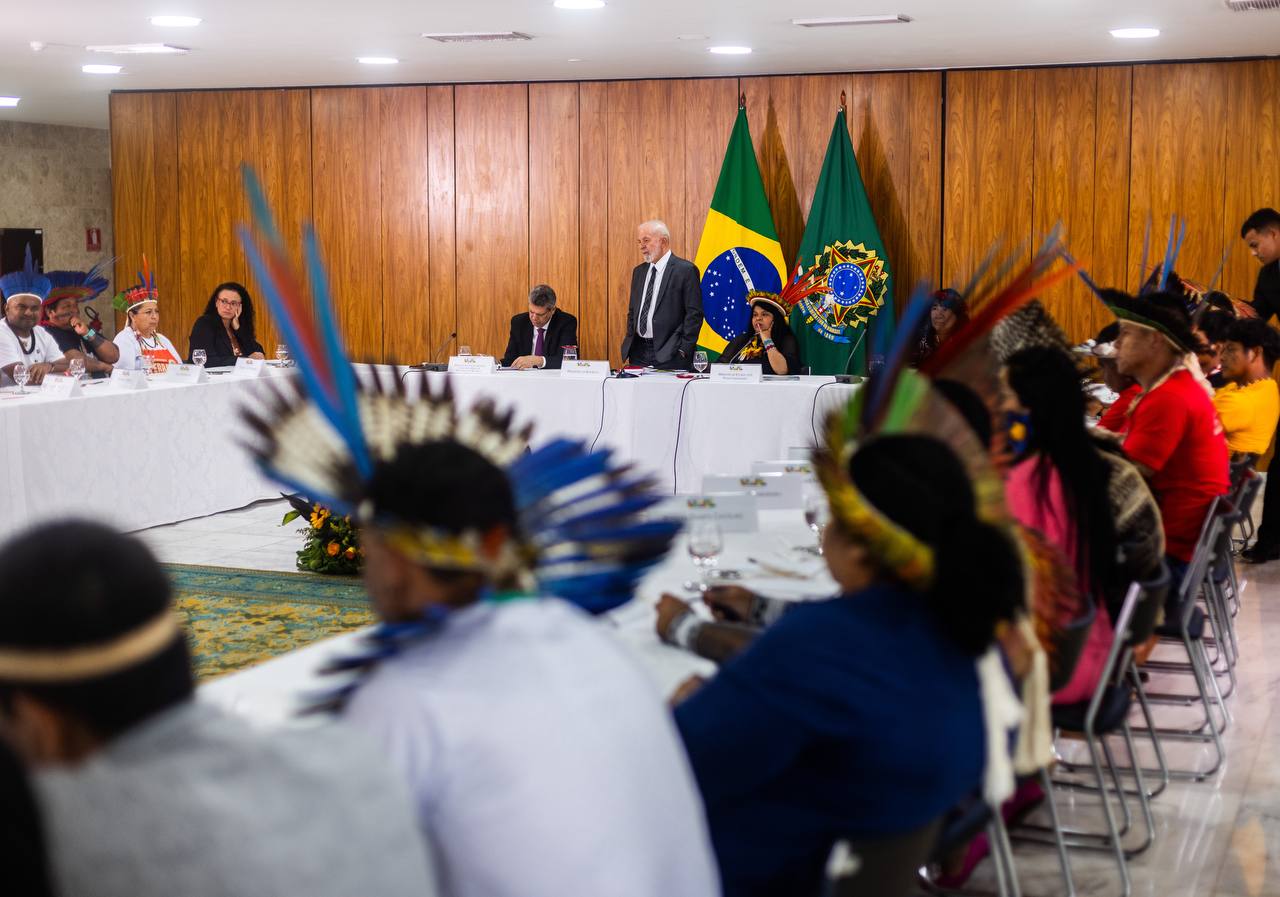
April, 2024 — President Luiz Inácio Lula da Silva met with a delegation of 40 indigenous leaders from across Brazil last Thursday (25) afternoon at the Palácio do Planalto. The gathering, which took place during the 20th edition of the Free Land Camp (Acampamento Terra Livre ATL)- the largest indigenous mobilisation in the country- concluded with the creation of a Task Force to advance land titling. 

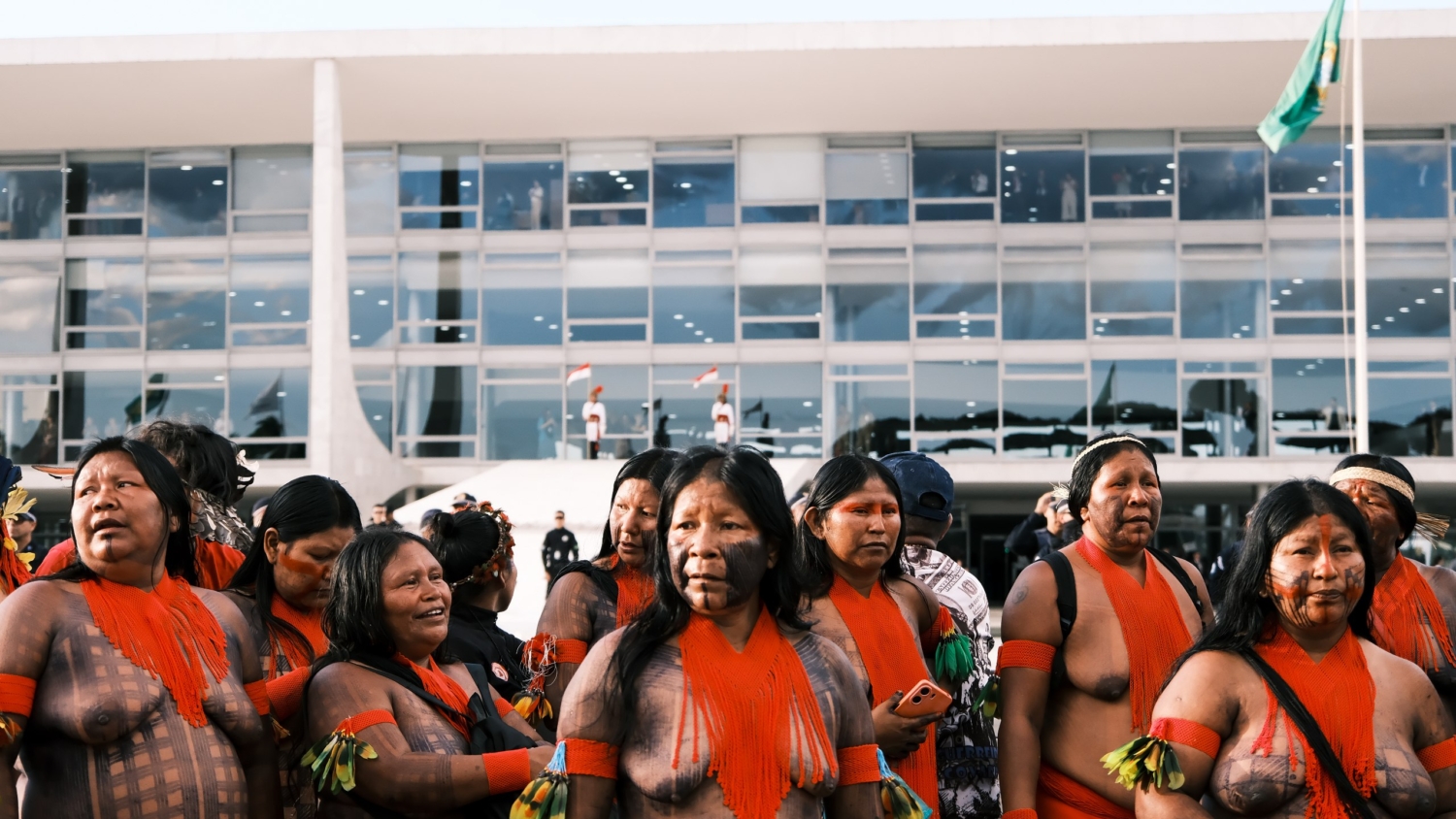
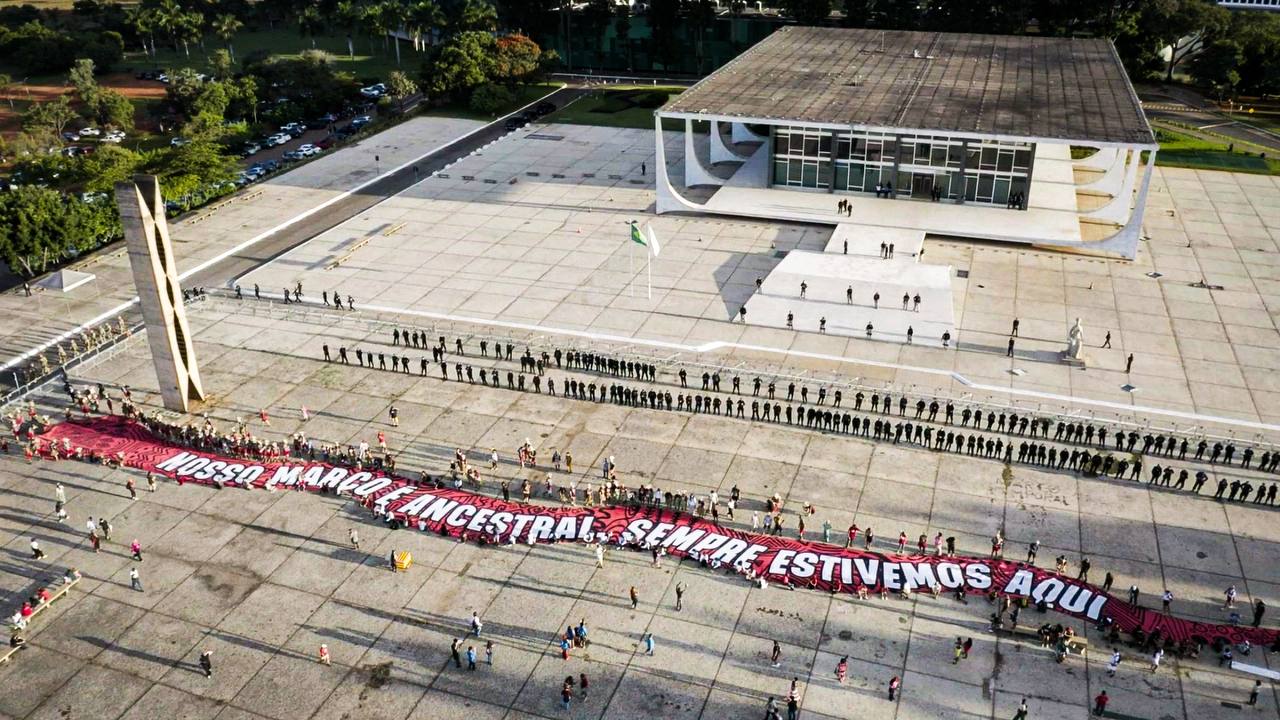
The meeting followed a massive march where eight thousands of Indigenous Peoples and Civil Society Movements filled the city’s central area with echoing chants and energetic calls for the government to advance land titling and stop large projects that pose threats to their territories.  The rally ended at the Praça dos Três Poderes, where groups of indigenous organisations continued on with their protest as the meeting took place.

APIB leaders at a conference discuss government delays in land titling and the impact of the Time Frame Thesis
Dinamam Tuxá speaks about the political impediments to land titling and the hopes for resolution through the task force

Photos: Kamikia Kisedje

The Articulation of Indigenous Peoples of Brazil (APIB) had been denouncing the government’s failed promise to title 14 indigenous lands in the first 100 days of Lula’s government. In over a year they had titled 10 of those lands, whilst many others awaited. Moreover, they raised alarms as Congress debated passing a law that could severely limit their rights to land, the Time Frame Law (Marco Temporal). 

“In our understanding, there is no legal impediment to land titling. What there is is a political impediment, which we hope will be resolved with this task force, which is a demand from the indigenous movement, so that we can actually unblock land demarcations. Not only of the four lands, not only of the 25 lands with declaratory ordinances [already signed], but so that, once and for all, we can overcome administrative and political issues for demarcating indigenous lands in the country,” said Dinamam Tuxá, a Executive Coordinator to APIB. 

Responding to the primary demands of APIB, the government announced the establishment of a governmental task force aimed at unlocking pending land titling processes awaiting presidential approval. Priority will be given to four key areas–including the Xukuru e Morro dos Cavalos- each mired in disputes awaiting resolution.

The task force, chaired by Minister Guajajara, will collaborate with key governmental bodies, including the Office of the Presidency, the Ministry of Justice and Public Security, the Ministry of Agrarian Development and Family Farming, the Attorney General’s Office (AGU), and the National Foundation of Indigenous Peoples (Funai).

indigenous women marching in Brasilia calling for land rights and an end to large projects threatening their territories
Photo: Lia Bianchini
woman holding a sign that says, "Land titting for the Cerrado ecosystem"
Photo: Adrian Arantos

Indigenous movement mobilised against a bill that severely hinders their rights and projects harding their territories

During the 20th edition of the Free Land Camp (Acampamento Terra Livre), Indigenous Peoples took over Brasilia’s streets with over 8,000 thousand peoples from over 200 distinct indigenous ethnic groups. In their chants, they argued against the Time Frame Thesis (Marco Temporal) and large projects like the Ferrogrão which threaten their rights and territories. 

The “Time Frame thesis” is a legal concept asserting that Indigenous peoples are entitled to claim only the lands they inhabited exactly on October 5, 1988, the date of Brazil’s Constitution promulgation. The proposition does not acknowledge the centuries old history of Indigenous Peoples of the country and does not account for the forced displacement they suffered during Brazil’s dictatorship in the 20th century. As a response, the indigenous movement united under the “Our time frame is ancestral” argument. 

Indigenous leaders walked through Brasilia next to a large truck that was wrapped to simulate a “train of death”, signaling their opposition to the Ferrogão railing project. The new train route would cut through sacred indigenous lands in the Amazon to facilitate soy exports. Monoculture of soy is one of the leading causes of deforestation and land grabbing, and the train would only aggravate the circumstances.

indigenous representatives march along a large fabric made snake which represents indigenous cosmovision
Photo: Jaye Renold
https://globalalliance.me/wp-content/uploads/2024/05/Kamikia-Kisedje-3.jpeg 1141 1280 GATC https://globalalliance.me/wp-content/uploads/2023/07/global-alliance-of-territorial-communities-logo-tight.png GATC2024-05-03 06:11:442024-10-25 21:58:42Brazil Creates an Indigenous Task Force to Advance Land Rights in the Country

Pages

  • COP28
  • Food Systems COP16
  • Home
  • MINGA Foodways – COP30 & Beyond
  • Movements
  • Privacy
  • Resilience
  • Shandia Forum 24
  • Strategic Plan 2025 & 2026
  • Strategic Plan 2026
  • Strategic Plan for 2024 and 2025
  • Workshop: Tracking Funds for Indispensable Partners
  • About
  • New York Climate Week 2023
  • News & Events
  • Shandia
  • Transparency
  • tester

Categories

  • Events
  • News

Archive

  • July 2026
  • June 2026
  • March 2026
  • December 2025
  • November 2025
  • September 2025
  • August 2025
  • June 2025
  • May 2025
  • April 2025
  • October 2024
  • September 2024
  • June 2024
  • May 2024
  • December 2023
  • November 2023
  • October 2023
  • September 2023
  • August 2023
  • June 2023
  • November 2022
© Copyright - Global Alliance of Territorial Communities - powered by Enfold WordPress Theme
  • Link to Instagram
  • Link to X
  • Link to Facebook
  • Link to LinkedIn
Scroll to top Scroll to top Scroll to top